Tuesday, February 22, 2005
In New York, War Is Indeed Hell, but Only After 10 PM
Tonight's installment of Frontline on PBS featured military personnel in combat situations in Iraq. Not surprisingly, they use colorful language in certain situations. PBS sent stations a heavily edited version and required that they sign a waiver acknowledging that PBS could not protect them from the FCC if they wanted to receive and transmit the unedited version. This differed from the normal PBS policy where they would simply send out both versions and permit the stations to choose which to play. Editorialists have cleverly labeled the edited version the "War is Heck" episode.
I am glad that the New York PBS station didn't fully capitulate to this censorship by playing the edited version. They did, however, move Frontline from its normal 9 pm slot to 10 pm. This action got them out of the FCC's indecency guidelines. While obscenity is prohibited at all times, the Supreme Court has ruled that indecency in broadcast can only be prohibitted when children will be listening or watching, so indecency is only actionable from 6 AM to 10 PM. Indecency is "language or material that, in context, depicts or describes, in terms patently offensive as measured by contemporary community standards for the broadcast medium, sexual or excretory organs or activities." In clear contrast to the plain meaning of this language, the FCC has ruled that in interpreting the "community standards for the broadcast medium", "The determination as to whether certain programming is patently offensive is not a local one and does not encompass any particular geographic area. Rather, the standard is that of an average broadcast viewer or listener and not the sensibilities of any individual complainant." Thus different standards don't exist between New York and Mississippi.
The three prong test for obscenity is: "(1) an average person, applying contemporary community standards, must find that the material, as a whole, appeals to the prurient interest; (2) the material must depict or describe, in a patently offensive way, sexual conduct specifically defined by applicable law; and (3) the material, taken as a whole, must lack serious literary, artistic, political, or scientific value." See Miller v. California, 413 U.S. 15 (1973).
The third prong prevents just about anything mainstream broadcasters would broadcast from being considered obscene. While I was a DJ at WQFS and was fighting for a safe harbor from 10-6, I tried to explain this to the management, but they could never understand the conjunctive nature of the test. All three prongs have to be met. The 1st Amendment ensures that material with artistic or political merit can be broadcast when young children are not likely to be listening. The FCC doesn't like this, so it tries to intimidate broadcasters. With small operations like WQFS it succeeds. They have to worry about periodically having their license renewed and can't afford to upset the FCC. WNET was willing to play the episode after 10 but still has to worry about retaining federal support in these days of reduced corporate underwriting.
I am glad that the New York PBS station didn't fully capitulate to this censorship by playing the edited version. They did, however, move Frontline from its normal 9 pm slot to 10 pm. This action got them out of the FCC's indecency guidelines. While obscenity is prohibited at all times, the Supreme Court has ruled that indecency in broadcast can only be prohibitted when children will be listening or watching, so indecency is only actionable from 6 AM to 10 PM. Indecency is "language or material that, in context, depicts or describes, in terms patently offensive as measured by contemporary community standards for the broadcast medium, sexual or excretory organs or activities." In clear contrast to the plain meaning of this language, the FCC has ruled that in interpreting the "community standards for the broadcast medium", "The determination as to whether certain programming is patently offensive is not a local one and does not encompass any particular geographic area. Rather, the standard is that of an average broadcast viewer or listener and not the sensibilities of any individual complainant." Thus different standards don't exist between New York and Mississippi.
The three prong test for obscenity is: "(1) an average person, applying contemporary community standards, must find that the material, as a whole, appeals to the prurient interest; (2) the material must depict or describe, in a patently offensive way, sexual conduct specifically defined by applicable law; and (3) the material, taken as a whole, must lack serious literary, artistic, political, or scientific value." See Miller v. California, 413 U.S. 15 (1973).
The third prong prevents just about anything mainstream broadcasters would broadcast from being considered obscene. While I was a DJ at WQFS and was fighting for a safe harbor from 10-6, I tried to explain this to the management, but they could never understand the conjunctive nature of the test. All three prongs have to be met. The 1st Amendment ensures that material with artistic or political merit can be broadcast when young children are not likely to be listening. The FCC doesn't like this, so it tries to intimidate broadcasters. With small operations like WQFS it succeeds. They have to worry about periodically having their license renewed and can't afford to upset the FCC. WNET was willing to play the episode after 10 but still has to worry about retaining federal support in these days of reduced corporate underwriting.
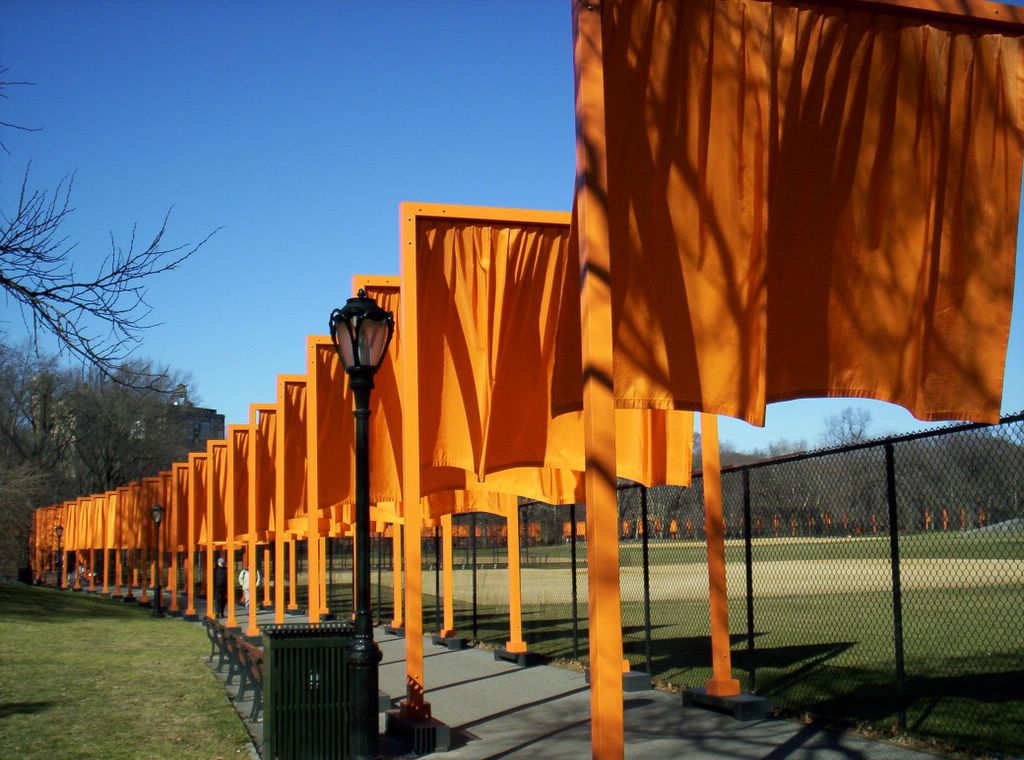
And yet more again.

And yet more.
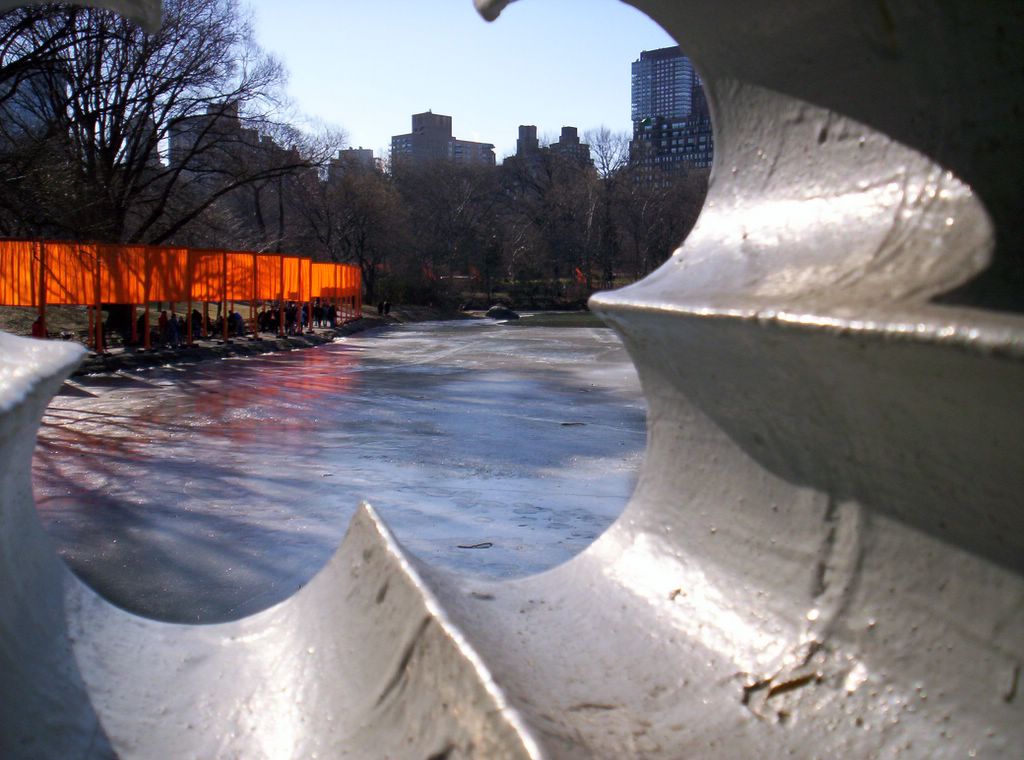
Photos from Christo's Gates this Saturday.
Tuesday, February 01, 2005
A Historical Comparison
Greensboro's Proudest Moment
I moved to New York from Greensboro, NC in October, having lived there for two years. Greensboro is an interesting town with vibrant institutions, and one of those is NC A&T State University. 45 years ago today, 4 A&T freshmen went down to the local Woolworth lunch counter and demanded service. While they succeeded in integrating Greensboro's retailers, their greater significance is in helping spark the wider civil rights movement. This is one of Greensboro's proudest moments (but also one of its shames for how the students were treated by the community for years after the sit-in). The New York Times has an article (free registration required) on the sit-in and a documentary on PBS's Independent Lense which focuses on the 4; Franklin McCain, Ezell Blair Jr. (now Jibreel Khazan), Joseph McNeil and David Richmond. On channel 13 in New York, it airs tonight (Tues.) at 10 and again on Mon., Feb. 7 at 12:30 am (which is really Sunday night).
New Photo Capacity
I just got a digital camera which should prove very exciting for the blog. The first thing I did was post pictures of the set lists from the Mission of Burma show a couple weeks back. Go take a look under the Jan. 19 post. Expect more photos to come.
